Same Risk, Higher Reward: How Startups Improve Their Treasuries with Federal Agency Bonds
Palus believes that startups’ cash reserves should be put into safe, suitable assets. Startups we work with often invest long-term cash into federal agency bonds. This article explains what they are, how they work, and why they tend to provide higher yields while suiting the needs of startups’ long-term cash.
Let’s start with a basic question: What's the safest thing you can do with your money?
The simplest answer is lend it to the U.S. government. When you buy a Treasury bill, you're giving the government cash today in exchange for a promise for repayment with interest. The risk of the U.S. government failing to pay you back is essentially zero; after all, it can always print dollars to honor its debts. That's why Treasuries are considered the default "risk-free" benchmark in finance.
This is basically what a money market fund does on your behalf: it pools cash from many investors and parks it in Treasuries and other very short-term government debt. It's the default option most companies use for idle cash, and it's extremely safe. But as we'll see, it's not the only option.
In other words: when you hear “Treasuries,” think “safe”. Now let's build up from there.
What's a mortgage-backed security (MBS)?
When a bank gives someone a home loan, it doesn't usually keep that loan on its books forever. Instead, it sells the loan.
A loan is really just a contract that says "Alice will pay Bob $X over time with interest." That contract has value since whoever holds it collects the payments. Selling a loan means transferring that right to collect in the future in exchange for cash today.
A mortgage-backed security bundles thousands of home loans into a single financial product. Investors buy slices of the bundle and receive the monthly mortgage payments from all those homeowners as their return.
Think of it like this: instead of lending money to one homeowner, you're lending to thousands of them at once. Diversification makes it safer than any single loan.
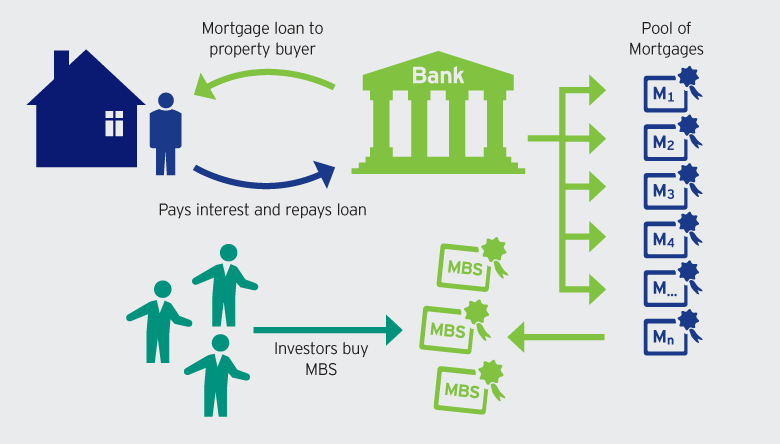
Source: go-yubi.com
And what are agency MBS?
Agency MBS are mortgages that have been purchased and guaranteed by one of three U.S. government agencies: Fannie Mae, Freddie Mac, and Ginnie Mae.
When these agencies guarantee an MBS, they're making a promise: even if homeowners default on their mortgages, you still get paid. The agency absorbs the credit loss, not you.
This is what makes them extremely safe.
These three agencies are backed by the U.S. government, and borrower defaults have never caused an Agency MBS investor to lose principal.
A note on 2008
If you've heard of mortgage-backed securities before, it might’ve been in the context of the 2008 financial crisis, when there was a huge wave of mortgage defaults and the government intervened to stabilize the market.
But the products that blew up in 2008 were very different. Those weren’t agency MBS; they were private-label MBS, bundles of high-risk mortgages, issued to people who couldn’t afford them, packaged by Wall Street banks with no government guarantee.
Agency MBS are fundamentally different. The mortgages in agency pools must meet strict underwriting standards: minimum credit scores, maximum loan-to-value ratios, and income documentation requirements. Combined with the government guarantee, this is why agency MBS investors got through 2008 without losing a single dollar of principal.
Even during the worst crisis for the mortgage market in modern history, agency MBS holders made it through unscathed. And since then, regulations and underwriting standards have gotten much stricter, making today's agency MBS pools even safer than the ones back then.
In other words, the 2008 crisis was evidence for the safety of agency MBS, not an indictment of it.
So why does agency MBS pay more than Treasuries?
If the credit risk of MBS and Treasuries are essentially the same (i.e. zero), why would agency MBS pay a higher yield? In other words, what’s the tradeoff? A couple of reasons that add up:
The main one is that agency MBS are slightly less liquid than Treasuries or money market funds. With a money market fund, you can usually sell and cash out same-day; with MBS, selling can take one to two business days to settle. Agency MBS are one of the deepest, most active markets on the planet: the daily trading volume of MBS is roughly the same as the entire US stock market combined. In other words, there will always be a buyer, but it's not instant cash.
Also, because homeowners can refinance or move at any time, the timing of your cash flows is less predictable than a Treasury that pays on a fixed schedule. When a homeowner refinances or moves, they pay off their mortgage early to the MBS holders. There's no loss, but the timing can vary. That said, because each MBS pool contains thousands of loans, any single prepayment is a drop in the bucket.
None of these are risks in the scary sense: you still get all your money back, backed by the same government guarantee.
For cash you need tomorrow, these differences might matter. But for the part of your treasury that's sitting idle for months (which for most startups is the majority of it!) a day or two of settlement time and some variability in cash flow timing aren’t a problem. That's the cash Palus is designed for.
The market compensates investors for these small tradeoffs with a spread: typically 1–1.5% of additional annual yield above money market funds. For long-term cash reserves, this is an exceptionally good deal.
What does "floating-rate" add to the picture?
So far we've described agency MBS in general. But Palus specifically invests in floating-rate agency MBS, which adds one more layer of protection.
Many bonds, including most mortgages, pay a fixed interest rate. If market rates rise after you buy a fixed-rate bond, you're stuck earning below-market returns (and the market value of your bond drops). This is called interest rate risk, and it's the primary risk in most bond investments.
A quick detour: What is SOFR?
You'll see the term SOFR, the Secured Overnight Financing Rate, come up in this context. SOFR is the standard benchmark rate for short-term interest rates in the US. When you hear in the news about the Federal Reserve raising or lowering rates, SOFR is what moves as a result.
As the main interest rate benchmark in the economy, most yields, including the yield on your money market fund, are based on SOFR. It's also the baseline for most floating-rate financial products, such as the MBS we're discussing, as well as credit card interest, corporate bonds, etc. There are typically priced as SOFR plus some fixed percentage (e.g. “SOFR + X%”).
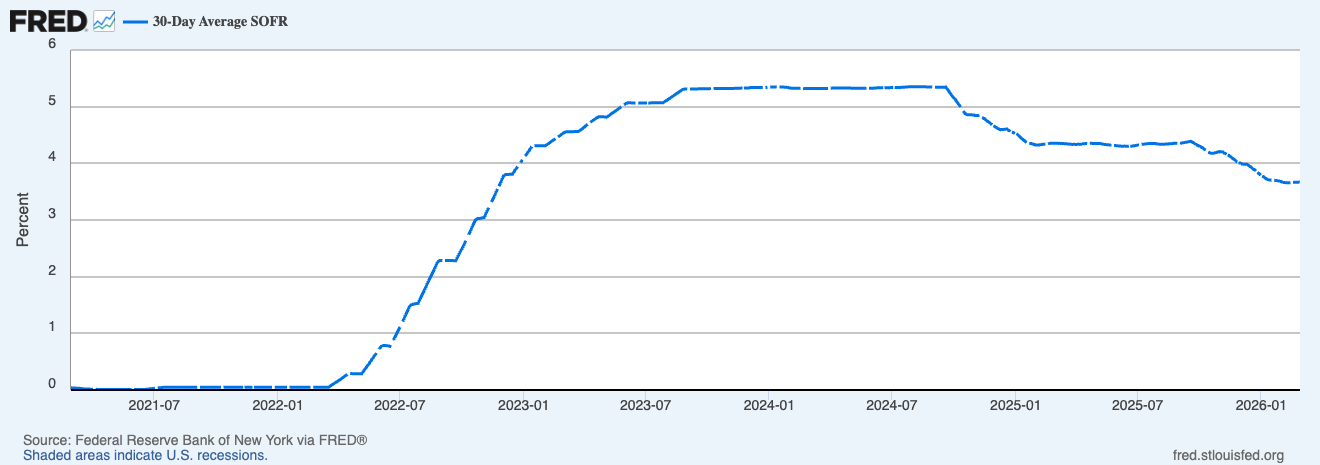
Federal Reserve Bank of New York, 30-Day Average SOFR [SOFR30DAYAVG], retrieved from FRED, Federal Reserve Bank of St. Louis; https://fred.stlouisfed.org/series/SOFR30DAYAVG, February 28, 2026.
Back to floating rate: What does it add to the picture?
Floating-rate agency MBS eliminates interest rate risk. The interest rate resets periodically (typically monthly) to track SOFR, so the market value stays very close to its face value regardless of how interest rates move.
Here's the key comparison: a money market fund pays you very close to SOFR (sometimes plus or minus 0.1%), while floating-rate agency MBS pays you SOFR + 1% to 1.5%. And no matter how SOFR changes, that difference will stay about the same.
In other words: these bonds have the same base rate and the same government backing, but MBS holders earn significantly more yield.
Putting it all together
Floating-rate agency MBS give you:
- Government-backed safety: Like in a money market fund, US government agencies guarantee you'll be paid, even if borrowers default.
- Stable principal: The floating rate adjusts with the market, so your assets hold their value no matter how interest rates change.
- Higher yield: You earn 1%–1.5% more per year than a money market fund. That advantage holds whether rates go up, down, or sideways.
Until now, this has been an institutional strategy: big companies with dedicated finance teams have used agency MBS for decades to earn more on their cash without taking on meaningful risk. But for startups, accessing these markets meant navigating broker-dealers, bond math, and settlement infrastructure that just isn't built for you.
But even for startups, this extra yield is still significant. A $5M allocation would earn an extra $50,000–$75,000 per year. That’s about half a junior engineer’s annual salary, for free, just from your money sitting in a smarter place.
That's what Palus is here for. We and our partners handle all the complexity – sourcing, trading, custody, reporting – so you can put your idle cash to work in the same instruments the institutions use, without needing a treasury team to do it.
—-
This post is for educational purposes only and does not constitute financial, investment, or legal advice. Past performance does not guarantee future results. Yields and spreads referenced are approximate and based on historical data.